 ultimate-guide
Why CNC Machine Downtime Happens (And How to Stop It)
Table of Contents
- The Real Cost of CNC Machine Downtime
- Mechanical Failures: The Most Common CNC Machine Downtime Causes
- Operator Error, Training Gaps, and Setup Inefficiency
- Software, Firmware, and CNC Control System Failures
- Environmental Factors and Supply Chain Gaps That Stop Production
- Predictive Maintenance for CNC Machines: From Reactive to Data-Driven
- CNC Machine Preventative Maintenance Checklist
- Conclusion
Last Updated: August 28, 2026
The Real Cost of CNC Machine Downtime
CNC machine downtime is one of the most expensive problems a manufacturing operation can face, and most shops underestimate it. Unplanned downtime doesn't just stop a machine, it ripples through your entire production schedule. Deliveries slip, overtime costs spike, and scrap rates climb while operators scramble to compensate. Understanding why CNC machine downtime happens is the first step toward stopping it.
How to Calculate CNC Machine Downtime Cost Per Hour
CNC machine downtime cost is calculated by multiplying your machine's hourly contribution margin by the total hours of unplanned downtime in a given period.
| Variable | What to Measure |
|---|---|
| Hourly revenue contribution | Revenue generated per machine hour at full use |
| Labor cost per hour | Operator wages + overhead during idle time |
| Scrap and rework cost | Parts scrapped or reworked due to the downtime event |
| Expediting cost | Rush shipping, overtime, or subcontracting to recover schedule |
| Total downtime cost | (Hourly contribution + Labor + Scrap + Expediting) × Hours down |
Most shops focus only on the repair invoice. The real number, when you include lost throughput and recovery costs, is typically several times higher. According to the U.S. Department of Energy's Advanced Manufacturing Office, unplanned downtime is among the leading sources of lost productivity in discrete manufacturing.
Mechanical Failures: The Most Common CNC Machine Downtime Causes
Mechanical failure accounts for the largest share of unplanned downtime in most CNC environments. What separates high-uptime shops from chronically reactive ones is how early they catch it.
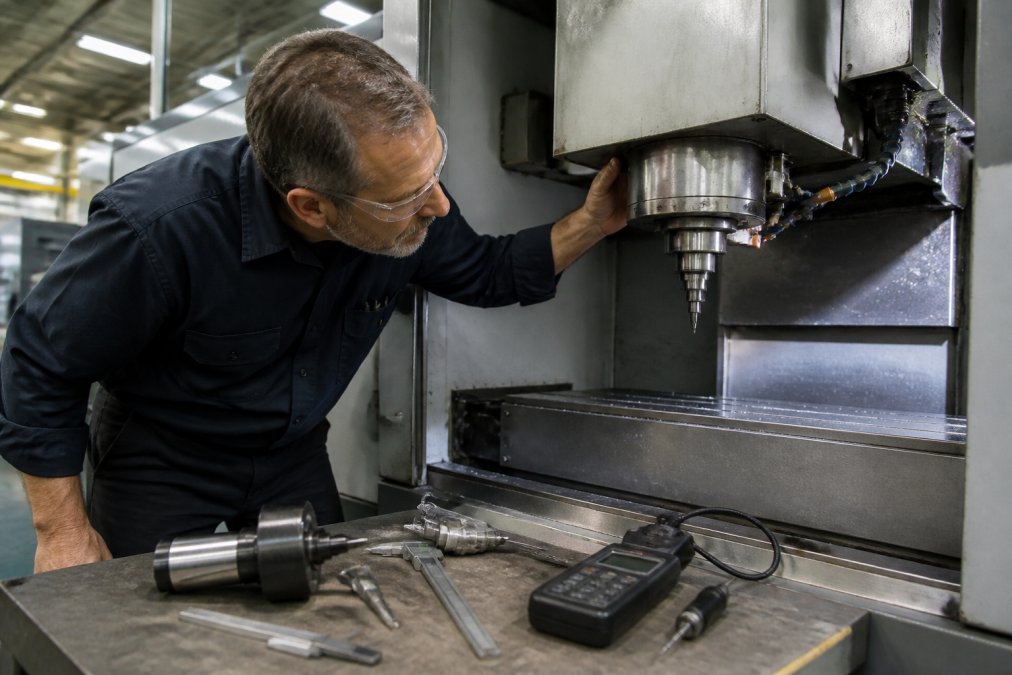
Spindle Failure and Bearing Wear
Spindle failure is the most catastrophic single-point mechanical failure in a CNC machining center. The warning signs are there long before failure: excessive vibration, unusual noise at specific RPM ranges, and surface finish degradation all indicate bearing wear. Vibration analysis can detect bearing defects well before they become spindle failures (peer-reviewed research). Shops that schedule spindle rebuilds proactively pay less in total repair cost than those that run spindles to failure.
Thermal Drift and Cooling System Failures
Thermal drift is the dimensional error introduced when a machine's structural components expand or contract due to temperature changes. For precision work held to tight tolerances, thermal drift silently produces out-of-spec parts. Sources include inadequate warm-up cycles, blocked coolant lines, and failed chiller units. Checking coolant concentration and flow on a scheduled basis is one of the highest-return maintenance tasks available.
Tooling Breakage and Component Wear
Tool breakage and accelerated component wear share a common root cause: running tools beyond their useful life or operating outside recommended cutting parameters. Running worn inserts to reduce tooling cost actually increases cycle time, raises scrap rates, and accelerates spindle wear. A structured tool life management program consistently reduces both tooling cost and unplanned stops.
Operator Error, Training Gaps, and Setup Inefficiency
Operator-related factors drive a substantial share of unplanned stops, and they're rarely captured in maintenance logs. Work offset errors are the most common culprit, an incorrect offset sends a tool into a fixture or part, producing a crash that can damage the spindle, toolholder, and workholding setup simultaneously.
Setup inefficiency compounds the problem. Long changeover times reduce machine use and increase pressure on operators to rush, raising the probability of setup errors. Standardizing setup procedures, including documented work offset verification steps and mandatory dry-run protocols for new programs, reduces both crash frequency and changeover time.
Training gaps are the underlying driver. Operators who don't fully understand the machine's control system will make errors that experienced operators avoid automatically. This is especially true when shops upgrade control systems without investing in updated training.
According to NIST's Manufacturing Extension Partnership program, workforce training and skills development are consistently identified as top priorities for improving productivity in small and mid-sized manufacturing firms.
Software, Firmware, and CNC Control System Failures
Software and firmware-related failures are an increasingly common source of CNC machine downtime, and they're harder to diagnose without the right knowledge. CNC control systems run on embedded software that requires periodic firmware updates. Shops that never update firmware are running systems with known bugs, some of which cause intermittent faults that are nearly impossible to reproduce on demand.
Parameter corruption is another underappreciated cause. Machine parameters store critical configuration data: axis limits, backlash compensation values, acceleration ramps. A power surge, failed battery backup, or improper recovery from an E-stop event can corrupt parameter sets, producing out-of-tolerance parts before anyone notices.
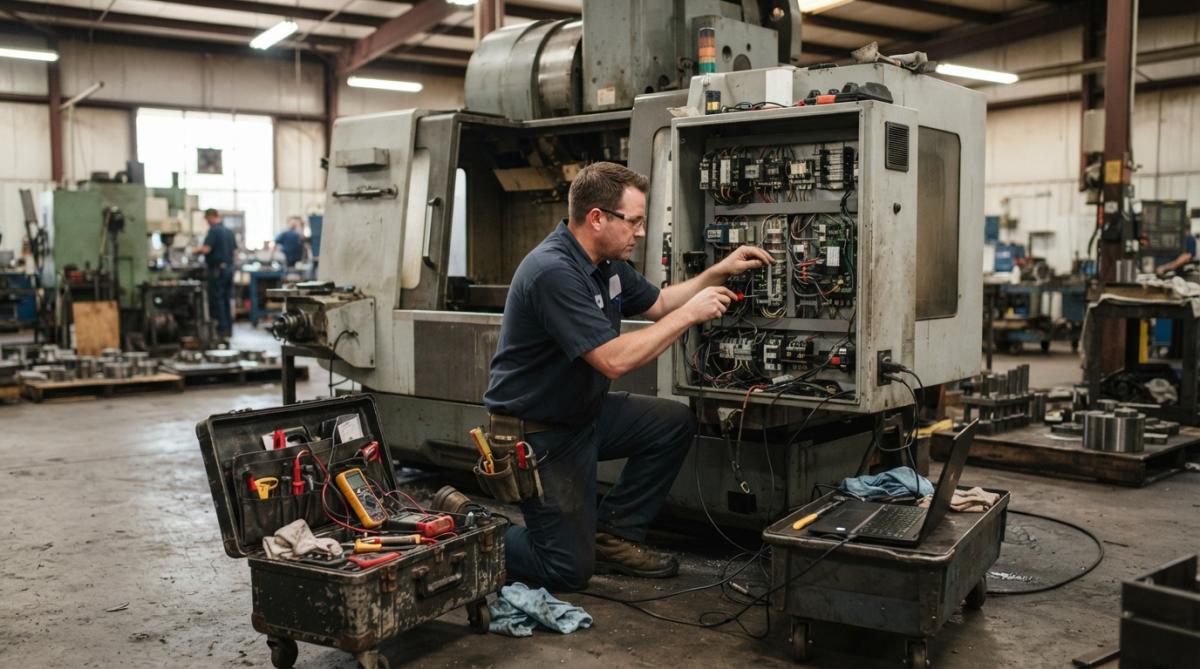
Control system diagnostics require a different skill set than mechanical troubleshooting. The technician needs to be fluent in the specific control platform to isolate a software fault from a hardware fault.
Environmental Factors and Supply Chain Gaps That Stop Production
Environmental factors beyond heat cause real downtime in manufacturing environments. Humidity affects electrical enclosures and control panels. In shops without climate-controlled electrical rooms, condensation inside control cabinets causes insulation breakdown and relay failures. Dust and coolant mist contamination of linear guides, ball screws, and optical scales accelerates wear and causes positioning errors.
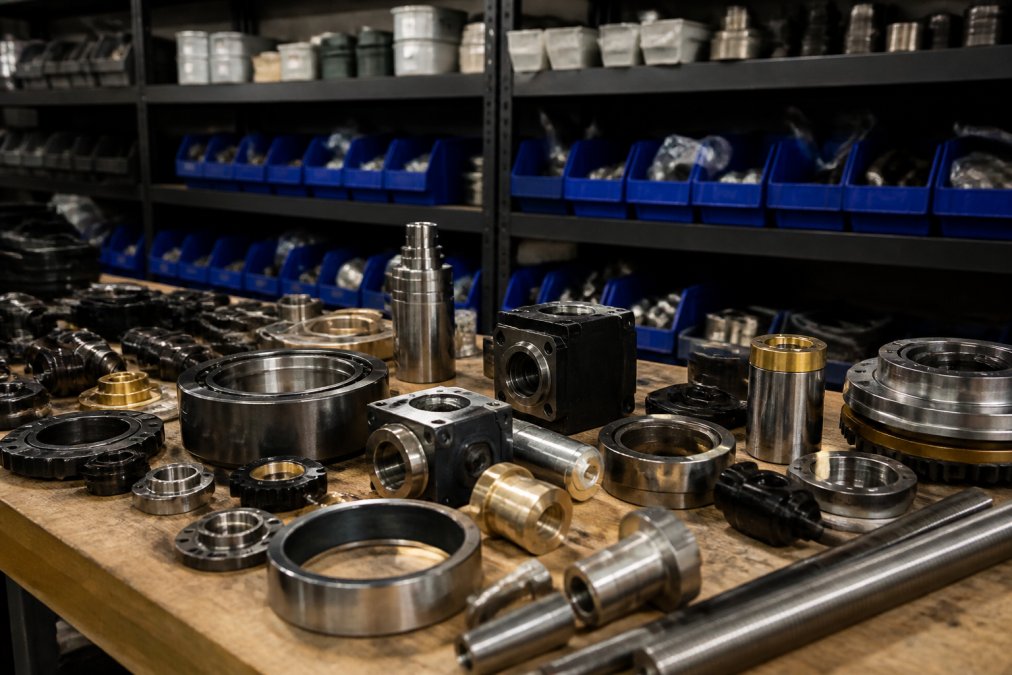
Supply chain logistics represent a different category of downtime risk. When a critical component fails, how quickly can you get a replacement? Shops with no spare parts inventory for high-wear items face extended downtime simply because the part isn't available. A practical approach is to maintain a small inventory of high-failure-rate consumables and critical wear parts for each machine. Working with a service provider who maintains component inventory reduces repair lead time significantly.
Predictive Maintenance for CNC Machines: From Reactive to Data-Driven
Predictive maintenance for CNC machines uses real-time sensor data and analytics to identify developing failures before they cause unplanned downtime. The core tools are vibration analysis sensors, thermal imaging, spindle load monitoring, and axis current draw analysis. A spindle bearing beginning to fail will show a characteristic vibration signature weeks before it produces audible noise or surface finish degradation.
Sensor integration doesn't require a complete machine retrofit. Many CNC control platforms support external data collection through standard interfaces. Even a basic vibration monitoring device mounted to the spindle housing provides actionable data that a scheduled visual inspection cannot.
OEE, Overall Equipment Effectiveness, is the standard metric for tracking the combined impact of availability, performance, and quality on machine use. Shops that track OEE consistently identify bottlenecks that pure uptime metrics miss. The transition from reactive to data-driven maintenance is a process, not a switch. Most shops start with basic sensor-based diagnostics on their highest-value machines, build a baseline, and expand from there.
CNC Machine Preventative Maintenance Checklist
A structured preventive maintenance plan is the most reliable way to reduce CNC machine downtime across a fleet of machines.
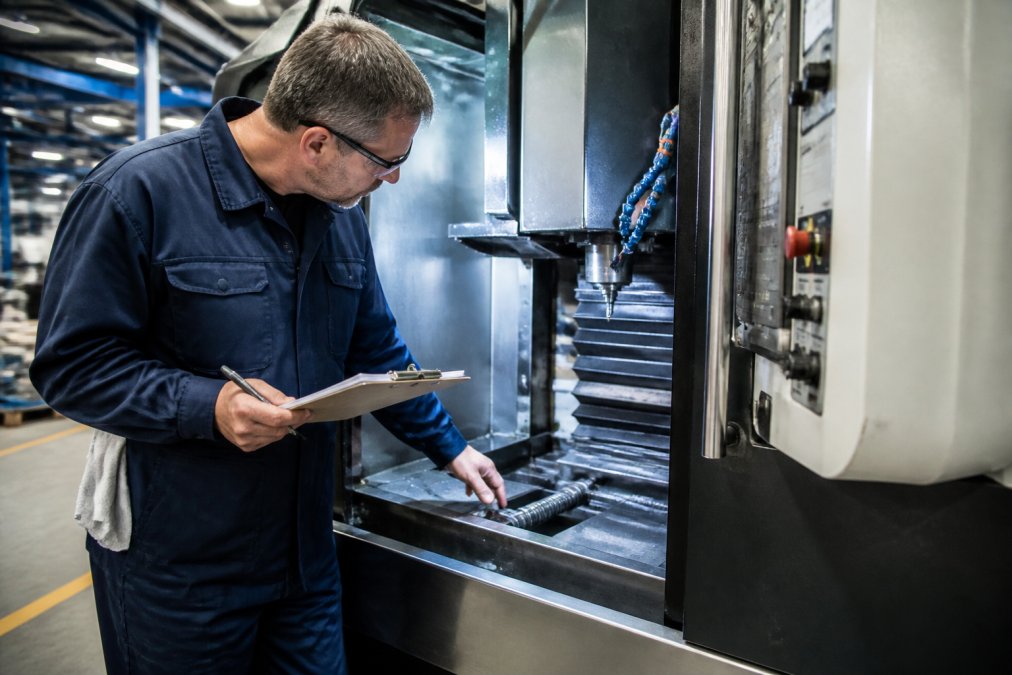
Daily and Weekly Tasks
Daily maintenance takes less than 15 minutes per machine and prevents the majority of contamination-related failures.
Daily tasks:
- Check coolant level and concentration
- Inspect coolant filter and chip conveyor for blockages
- Wipe down way covers and check for coolant or chip intrusion
- Verify lubrication system indicator confirms auto-lube cycle completed
- Check for any active alarms or fault codes on the control panel
- Inspect toolholders for damage, runout, or contamination before loading
Weekly tasks:
- Clean electrical enclosure exterior and verify cooling fan operation
- Check hydraulic fluid level (if applicable)
- Inspect air filter on pneumatic system and drain moisture trap
- Verify work offsets against a known reference part
- Check spindle for unusual noise or vibration during warm-up
- Inspect all visible cables and hoses for wear or chafing
Monthly and Quarterly Tasks
Monthly tasks:
- Check coolant concentration with a refractometer and adjust as needed
- Inspect and clean heat exchanger on electrical cabinet
- Verify axis backlash compensation values against machine specification
- Check ball screw lubrication and inspect for contamination
- Test E-stop and safety interlock function
- Review alarm history log for recurring fault codes
Quarterly tasks:
- Full spindle warm-up cycle and runout check with test indicator
- Calibration check on all linear axes using a ballbar or laser tracker
- Inspect and replace way lube filters
- Verify firmware version and check manufacturer release notes for updates
- Full coolant system flush and recharge if contamination is present
- Inspect and torque all toolholder retention knobs to specification
The maintenance scheduling intervals above are starting points. Machines running aggressive cutting cycles, difficult materials, or multiple shifts need more frequent attention on high-wear items.
Unplanned CNC machine downtime is rarely a mystery after the fact. The causes are predictable, the warning signs are detectable, and the prevention strategies are well-established. Machine Tool Science provides comprehensive diagnostic fault isolation, emergency CNC machine repair, and spindle rebuild services across the Southeast, with factory-trained technicians and transparent rates before any work begins. Whether you're building a preventive maintenance program from scratch or dealing with a machine that's down right now, get in touch with Machine Tool Science to talk through your situation and get a clear diagnosis before any parts are quoted.
Frequently Asked Questions
What is the difference between planned and unplanned CNC machine downtime?
Planned downtime covers scheduled maintenance, tooling changes, and setup between jobs. You control the timing and can minimize its impact on throughput. Unplanned downtime is a surprise stop caused by mechanical failure, software faults, or operator error. Unplanned events are far more damaging because they halt production without warning, often during high-priority runs, and they tend to take longer to resolve since parts and technicians must be mobilized reactively rather than proactively.
What are the most common mechanical failures that cause CNC downtime?
Spindle bearing failure ranks among the top causes of CNC machine downtime, followed by thermal drift from inadequate cooling, tool breakage from worn inserts or incorrect feeds and speeds, and ball screw or linear guide wear from missed lubrication cycles. Electrical faults in servo drives and encoder failures also appear frequently. Most of these failures give early warning signs, including vibration, abnormal noise, rising cycle times, and increased scrap rate, before a full stop occurs.
How does lack of preventative maintenance lead to CNC machine failure?
Skipping preventative maintenance allows small issues to compound. A missed lubrication cycle accelerates bearing wear. A clogged coolant filter raises spindle temperature and triggers thermal drift. Dirty air filters starve servo drives of cooling. Each neglected task shortens component lifespan and raises the probability of an unplanned stop. A documented preventative maintenance plan with daily, weekly, and monthly tasks is the most reliable way to extend machine uptime and protect OEE.
How can software and control system issues cause CNC production stops?
Outdated firmware can introduce parameter conflicts or fail to communicate correctly with servo drives, causing fault alarms that halt the machine. Corrupted work offsets or tool length data lead to scrapped parts or axis crashes. Memory errors in aging CNC controls produce intermittent faults that are difficult to diagnose without proper diagnostic tools. Regular firmware updates, periodic backup of machine parameters, and control system health checks are practical ways to reduce software-related downtime.
This article was written using GrandRanker