 ultimate-guide
CNC Spare Parts Inventory Availability: 2026 Guide
Table of Contents
- Why CNC Spare Parts Availability Determines Your Uptime
- Critical CNC Machine Components List: What to Stock Now
- How to Reduce CNC Machine Downtime Through Smarter Inventory
- Predictive Maintenance for CNC Machines and Inventory Planning
- Sourcing CNC Spare Parts: Lead Times, Vendors, and Counterfeit Risks
- Inventory Valuation, Depreciation, and Sustainability Considerations
- Conclusion
Last Updated: August 26, 2026
Why CNC Spare Parts Availability Determines Your Uptime
CNC spare parts inventory availability is an uptime problem. Every hour a machining center sits idle waiting for a backordered component translates directly into missed production schedules, late deliveries, and strained customer relationships. CNC machines combine precision mechanical assemblies, high-voltage electrical systems, and sophisticated CNC controls into a single production asset. When any one of those layers fails, the entire machine stops. If the replacement part has a six-week lead time, your production schedule is broken.
According to Manufacturing Leadership Council guidance on machine availability, unplanned downtime consistently ranks among the top operational challenges for discrete manufacturers. The remedy requires discipline: identify critical failure points in advance, stock the right components at appropriate levels, and build a sourcing strategy that accounts for real-world lead times.
Critical CNC Machine Components List: What to Stock Now
A critical CNC machine components list starts with one question: which parts, if unavailable, would stop production completely? The answer differs by machine type and age, but certain categories apply universally to vertical machining centers, horizontal machining centers, and CNC routers.
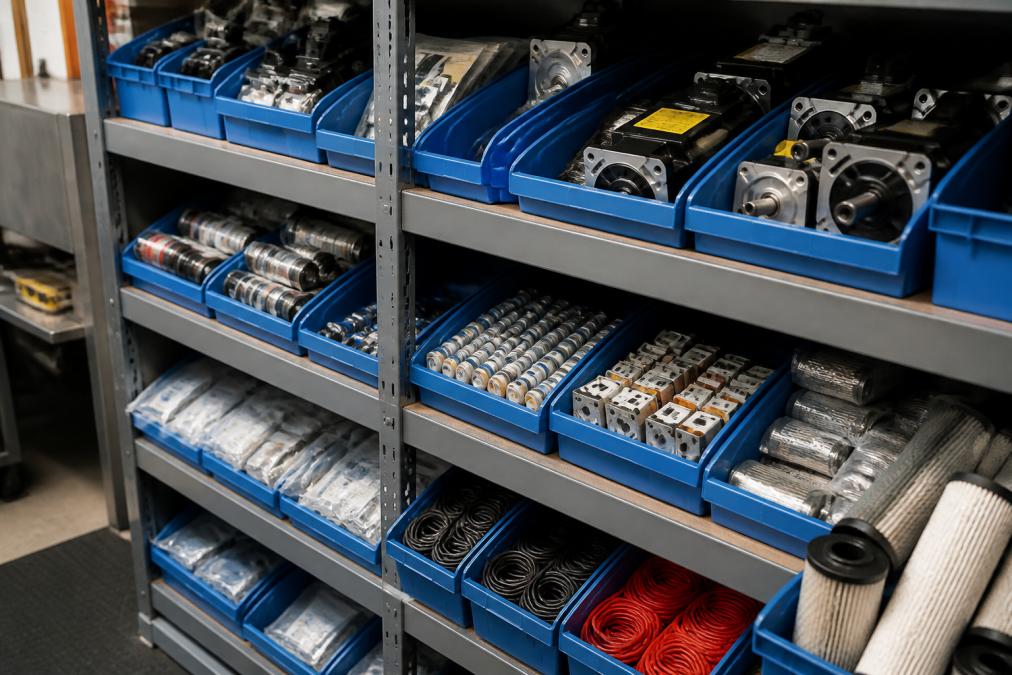
Electrical and Control Components
Electrical failures are among the most disruptive because they often present as ambiguous fault codes. Stocking common electrical parts eliminates diagnostic variables.
Priority electrical components to keep on hand:
- Fuses: main breaker fuses and axis drive fuses specific to your machine's voltage and amperage ratings
- Memory batteries: the lithium cells that retain parameter and program data; these fail silently and can cause catastrophic parameter loss
- Servo motor drive boards and amplifier cards for the most common axis configurations
- Limit switches for axis travel boundaries, door interlocks, and tool changer positions
- Tool setter probe tips and stylus assemblies
- Relay modules and contactor assemblies for spindle and coolant circuits
The memory battery deserves special attention. A power event can wipe the control's parameters, and recovery can take days if the original backup is missing. A battery that costs a few dollars prevents this costly downtime.
Mechanical and Wear Components
Mechanical wear is predictable. Bearings, seals, and drive components degrade on measurable timelines. The mistake most shops make is waiting for audible or tactile signs of failure before ordering replacements. By that point, secondary damage is often underway.
Mechanical components that belong in your critical spare parts inventory:
- Spindle bearings matched to your specific spindle cartridge specification
- Ball screw support bearings for each linear axis
- Servo motor couplings and flexible jaw inserts
- Coolant pump impellers and motor assemblies
- Way wipers and telescoping cover seals
- Tool changer gripper fingers and cam followers
- Timing belts for spindle orientation and ATC drives
For servo motors, identify a rebuild partner who can turn around a failed unit within 48 to 72 hours, and stock the smaller associated components that fail more frequently.
Filtration and Sealing Components
Filtration and sealing components are the most neglected category in most shops' spare parts programs. Degraded filtration does not stop the machine immediately but accelerates wear on every system downstream.
Filtration and sealing components to stock:
- Oil filters for the hydraulic unit and spindle lubrication system
- Air filters for the pneumatic circuit and electrical cabinet cooling
- O-rings for coolant manifolds, rotary unions, and hydraulic connections
- Hydraulic seals for tool clamping cylinders and counterbalance circuits
- Mist collector filter media if your machine runs through-spindle coolant
Stock these in quantities that cover at least three replacement cycles. Their low unit cost makes overstocking a non-issue.
| Component Category | Failure Impact | Recommended Stock Level |
|---|---|---|
| Memory batteries | High - parameter loss risk | 2-4 units per control type |
| Fuses and breakers | High - immediate shutdown | Full set per machine |
| Servo motor drive boards | High - axis down | 1 spare per common axis type |
| Limit switches | Medium - machine fault | 2-3 per switch type used |
| Spindle bearings | High - spindle down | 1 set per spindle configuration |
| O-rings and seals | Medium - leak and contamination | Full assortment kit |
| Oil and air filters | Medium - accelerated wear | 3+ replacement cycles |
| Tool setter probe tips | Low - measurement error | 4-6 tips per probe type |
How to Reduce CNC Machine Downtime Through Smarter Inventory
The faster lever for reducing downtime is inventory readiness: having the right component available the moment a failure is diagnosed. A well-maintained machine that waits three weeks for a servo drive card is still down.
Setting Minimum Stock Levels and Reorder Triggers
Minimum stock levels should be calculated from two inputs: the historical failure rate of each component and the realistic lead time from your supplier. If a relay module fails roughly once per quarter and your supplier needs ten business days to deliver, your minimum stock level is at least two units, with a reorder trigger set at one.
A practical framework for setting reorder triggers:
- List every component that has caused a production stoppage in the past 24 months
- Record the lead time for each component from your primary vendor
- Calculate average consumption rate based on your maintenance logs
- Set minimum stock at: (lead time in weeks × weekly consumption rate) + one safety unit
- Review and adjust quarterly as machine age and use change
OEM vs. Aftermarket vs. Refurbished Components
OEM components carry the manufacturer's specification guarantee and typically offer the cleanest compatibility. They also carry the highest price point and may have extended lead times for older machines.
Aftermarket components from reputable suppliers can offer equivalent performance at lower cost, but compatibility requires verification. Machining parameters, voltage ratings, encoder resolution, and physical mounting specifications must match exactly.
Refurbished components from qualified rebuilders can match OEM performance at a fraction of replacement cost, provided the rebuilder has access to original technical specifications and uses appropriate bearing grades and tolerances. Ask any rebuilder: what is the warranty, and what failure modes does it cover?
Use OEM for control electronics and safety-critical components. Use vetted aftermarket for filtration, sealing, and wear items where specifications are easily verified. Evaluate refurbished components case by case for high-cost mechanical assemblies.
Predictive Maintenance for CNC Machines and Inventory Planning
Predictive maintenance changes the inventory equation fundamentally. Instead of stocking parts against the possibility of failure, you stock parts against the probability of failure, calculated from real machine data.

Modern CNC controls collect significant diagnostic data: servo load percentages, thermal readings, vibration signatures, and cycle time deviations that indicate mechanical degradation. When trended over time, this data surfaces leading indicators of failure before it occurs.
According to NIST guidance on predictive maintenance in manufacturing, predictive maintenance programs that use machine condition data can substantially reduce unplanned downtime compared to purely reactive approaches.
Practical steps to integrate predictive maintenance with inventory planning:
- Enable and log all available diagnostic outputs from your CNC control
- Establish baseline readings for each axis and spindle during a known-good operating state
- Set alert thresholds at 80% of the alarm limit to create a response window before failure
- When an alert triggers, initiate procurement immediately, even if the machine is still running
- Use maintenance windows to replace components trending toward failure rather than waiting for failure
Predictive maintenance allows you to shift from emergency procurement to planned procurement with lead time on your side. That shift alone can meaningfully reduce both procurement costs and downtime duration.
Sourcing CNC Spare Parts: Lead Times, Vendors, and Counterfeit Risks
Lead time is the variable that most procurement strategies underestimate. A component that appears available may carry a two-to-four-week fulfillment window once back-order status is factored in. For older machine generations or specialized control systems, lead times of eight to twelve weeks are not unusual.
Vendor management should not be single-source. Identify at least two qualified suppliers for every critical component: one primary supplier with an established account and pricing agreement, and one secondary supplier who can fulfill on short notice.
Key criteria for evaluating spare parts vendors:
- Demonstrated access to your specific machine brands and control generations
- Ability to provide traceable documentation, including country of origin and manufacturer certifications
- Clear return policy for incorrect or defective components
- Realistic lead time commitments
Counterfeit part identification deserves serious attention. The market for counterfeit CNC components, particularly servo drives and control boards, is active. According to U.S. Customs and Border Protection guidance on counterfeit industrial components, counterfeit electrical and mechanical components represent a growing enforcement priority.
Practical counterfeit identification steps:
- Purchase critical components only from authorized distributors or directly from the OEM
- Request certificates of conformance and verify them with the manufacturer when justified
- Be skeptical of pricing significantly below market: a servo amplifier at 40% below standard pricing is a red flag
- Inspect packaging, labeling, and connector quality on receipt; counterfeit components frequently show inconsistencies genuine parts do not
Inventory Valuation, Depreciation, and Sustainability Considerations
Spare parts inventory carries real balance sheet implications. Under standard accounting treatment, spare parts held for maintenance use are classified as inventory assets. When consumed in a repair, they move to maintenance expense. Parts held for extended periods without use may require write-down if their value has declined.
This creates tension in inventory planning. Stocking generously reduces downtime risk but increases carrying cost and write-down exposure. Stocking minimally reduces carrying cost but increases downtime exposure and emergency procurement costs. The right balance depends on your machine use rate, machine criticality, and realistic component availability.
High-value spare assemblies such as spindle cartridges or servo motor sets have finite shelf lives even in storage: bearing grease degrades, seals dry out, and electronic components experience capacitor aging. Factor storage life into inventory planning decisions.
Refurbished and rebuilt components support circular economy objectives by recovering value from failed assemblies rather than sending them to scrap. As documented in EPA guidance on sustainable manufacturing practices, extending equipment service life aligns with broader environmental management objectives. For shops pursuing ISO 14001 certification or responding to customer sustainability requirements, a documented preference for rebuilt components where technically appropriate is defensible and auditable.
Operational efficiency in spare parts management comes down to treating your parts inventory with the same analytical discipline you apply to production inventory. Track turns, monitor shelf life, review your critical parts list against your actual machine population annually, and adjust stock levels as machines age and use patterns change.
Managing CNC spare parts inventory availability requires operational discipline that many shops build only after an expensive unplanned failure. Machine Tool Science works with manufacturers to get ahead of that failure, offering factory-trained technicians who diagnose root causes rather than guess at them, and transparent rates with no surprise billing. Whether you need emergency repair support, proactive maintenance planning, or guidance on sourcing the right components for your machining centers, contact Machine Tool Science to discuss how we can help keep your production running.
Frequently Asked Questions
What are the most critical CNC spare parts to keep in stock?
The highest-priority CNC spare parts are those tied to the most common failure points: memory batteries, fuses, main breakers, limit switches, servo motor drive components, tool setter probes, o-rings, oil filters, and air filters. These parts fail most often, carry short shelf lives, or have long lead times from suppliers. Stocking even a small quantity of each eliminates the most common sources of unplanned machine downtime without requiring a large capital investment in inventory.
Should you stock OEM or aftermarket CNC replacement parts?
OEM parts guarantee compatibility with your machine's technical specifications and are the safest choice for control components, servo motors, and anything tied to machining parameters or safety systems. Aftermarket parts can work well for wear items like filters, seals, and o-rings when sourced from a verified supplier. Rebuilt or refurbished components are worth evaluating for high-cost assemblies, provided they come with documented testing and a warranty. The key risk to avoid is counterfeit parts, which can cause secondary failures and void machine warranties.
How do supply chain delays affect CNC machine maintenance planning?
Extended lead times, sometimes 8 to 20 weeks for specialized control boards or servo drives, mean a single missing part can idle a machine for months. Supply chain disruptions amplify this risk. The practical response is to identify your machine's longest-lead components, stock at least one unit on hand, and build vendor relationships with multiple authorized distributors. Procurement planning tied to your preventive maintenance schedule reduces emergency sourcing situations and their associated premium costs.
How can predictive analytics improve CNC spare parts inventory management?
Predictive maintenance systems use sensor data, vibration, temperature, current draw, to flag components approaching failure before they stop working. When integrated with your parts inventory, this approach lets you order replacement servo motors, bearings, or spindle components based on actual wear data rather than fixed intervals. The result is fewer emergency orders, better inventory turnover, and less capital tied up in parts that sit unused. Even basic condition monitoring on spindles and drives can meaningfully reduce reactive procurement.
This article was written using GrandRanker