 comparison
Vertical Machining Center: 2026 Buyer's Guide
Table of Contents
- What Is a Vertical Machining Center?
- Key Components and How a VMC Works
- 3-Axis vs. 5-Axis Vertical Machining Centers
- Applications Across Industries
- CNC Machine Maintenance Tips for Long-Term Performance
- VMC Spindle Repair Services and Total Cost of Ownership
- CNC Machine Turnkey Installation and Industry 4.0 Integration
- Vertical Machining Center Comparison: Top Models and Selection Criteria
- Frequently Asked Questions
Last Updated: October 1, 2026
What Is a Vertical Machining Center?
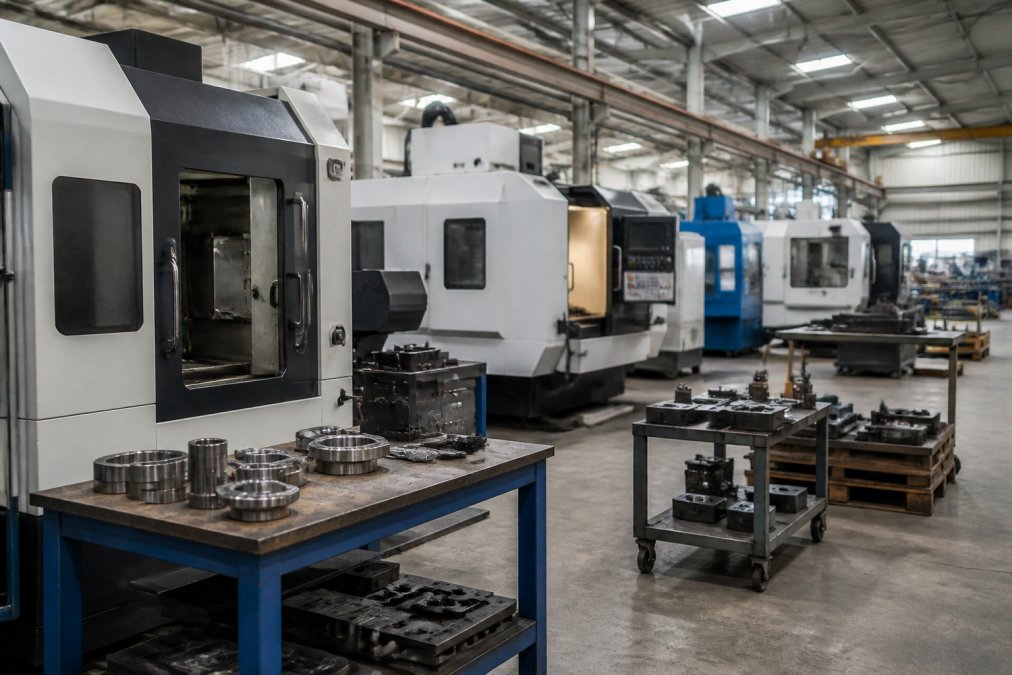
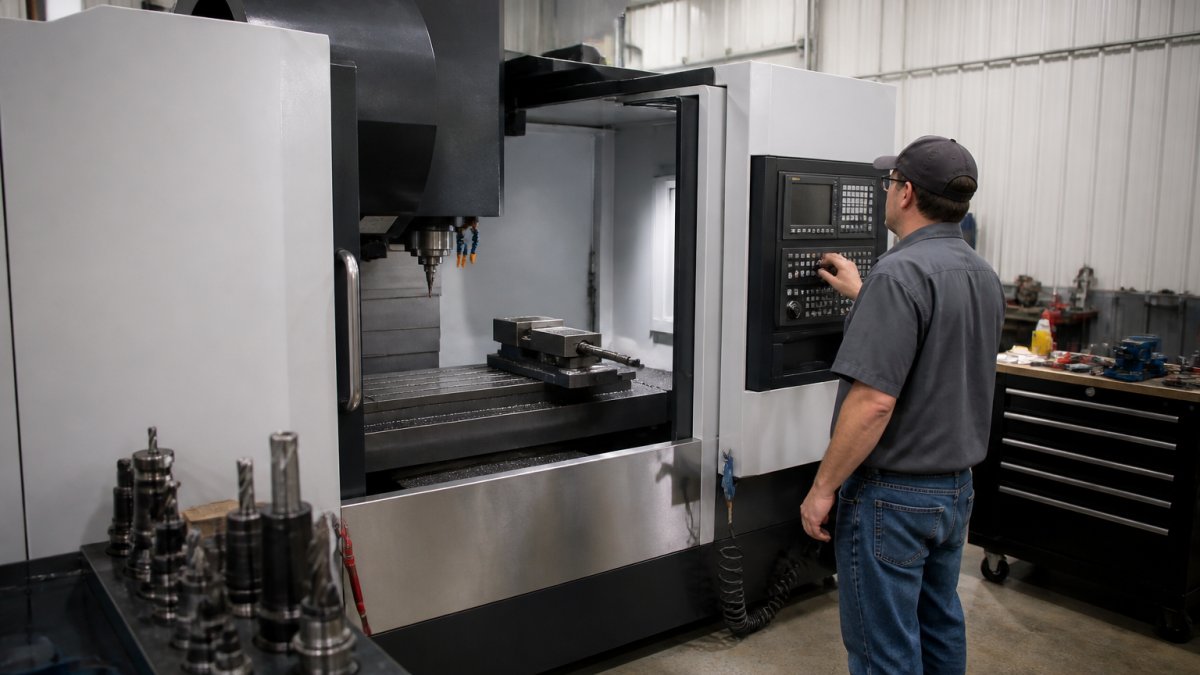
A vertical machining center is a CNC machine tool where the spindle orientation runs vertically, with the workpiece mounted on a horizontal table below it. The cutting tool moves up and down while the table can move side-to-side and front-to-back, creating precise cuts in metal, plastic, and composite materials.
This configuration suits plate-like components, molds, and precision parts requiring drilling, boring, tapping, and contouring. The vertical setup offers better visibility and easier loading than horizontal mills, critical for job shops and small-to-medium manufacturers.
The machine's rigidity, spindle speed capabilities, and automation features determine suitability for your application.
Key Components and How a VMC Works
A vertical machining center integrates the spindle (holds and rotates the cutting tool at hundreds to tens of thousands of RPM), tool changer (automatically swaps tools to reduce cycle time), and work envelope (the total area the machine can reach, determining maximum part size).
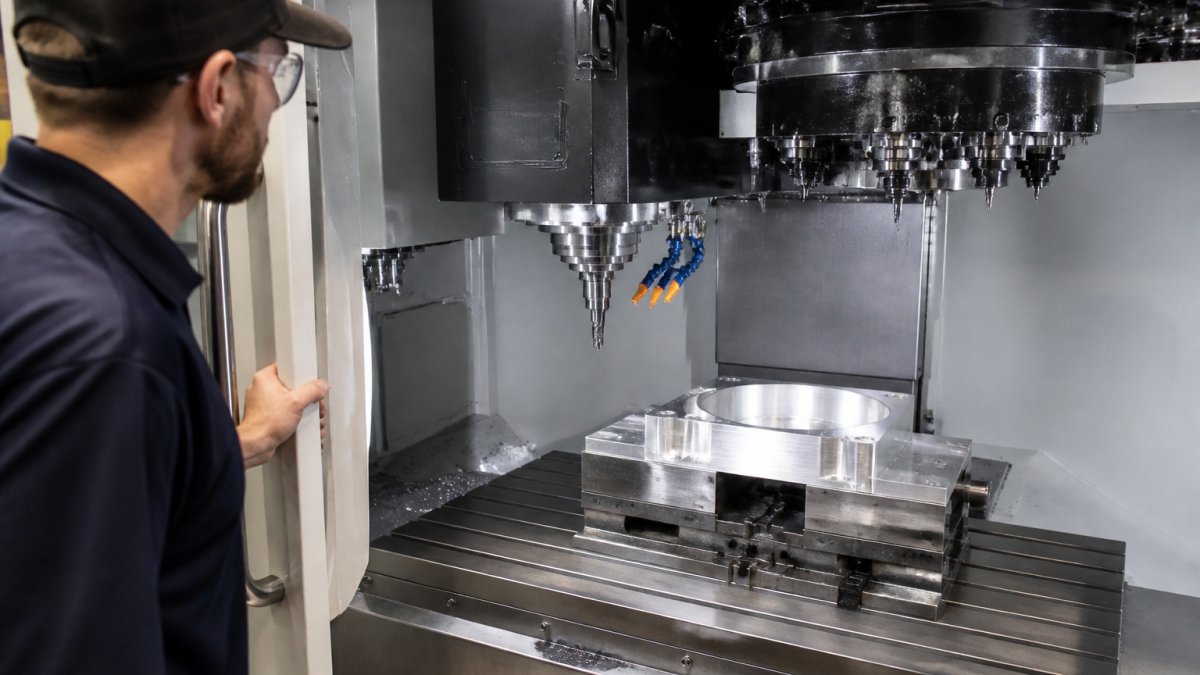
The programmable logic control (PLC) interprets the CNC program and orchestrates movement. Feed rate and spindle speed control metal removal rate and surface finish. The coolant system evacuates chips and cools the cutting zone, extending tool life.
Workpiece clamping is critical; poor fixturing causes vibration, tool breakage, and dimensional errors.
3-Axis vs. 5-Axis Vertical Machining Centers
A 3-axis vertical machining center moves in three directions: X, Y, and Z. It handles flat parts, cavities, pockets, and simple contours with straightforward setup and lower cost than multi-axis alternatives.
Applications Across Industries
Vertical machining centers serve aerospace and defense (titanium and aluminum components), automotive (engine blocks, transmission housings), and medical device (implants, surgical instruments) manufacturers.
CNC Machine Maintenance Tips for Long-Term Performance
Preventive maintenance extends machine life, but operator safety and training are equally critical to performance and regulatory compliance.
Preventive Maintenance Schedule
Check coolant levels daily and maintain proper concentration. Clean the work envelope regularly to remove chips that jam the table or damage bearings.
Operator Safety and Training: A Compliance and Performance Imperative
Vertical machining centers can cause serious injury if operated improperly. OSHA requires operators to be trained and competent. Proper training reduces scrap, improves tool life, and prevents accidents.
Core Safety Protocols:
1. Machine Guarding and Lockout/Tagout (LOTO)
- All moving parts must be guarded or interlocked to prevent contact
- Before maintenance, power down, stop the spindle, and disconnect power using LOTO procedures
- Never reach into the work envelope while the spindle is running
- Keep hands clear during automatic tool changes
2. Personal Protective Equipment (PPE)
- Safety glasses are mandatory
- Hearing protection is required (most VMCs exceed 85 decibels)
- Closed-toe shoes with non-slip soles are required
- Secure or remove long hair and loose clothing
- Avoid gloves near rotating equipment; they can be caught
3. Workpiece Clamping and Fixturing
- Verify all clamps are tight before starting the spindle
- Use appropriate fixtures; makeshift clamping causes accidents
- Never adjust or remove a workpiece while the spindle is running
4. Coolant System Safety
- Coolant reaches high temperatures; route and secure lines to prevent spraying
- Use coolant-resistant gloves when handling hot parts
- Dispose of coolant per local environmental regulations
5. Emergency Stop (E-Stop) Procedures
- Every operator must know the E-stop location and be trained to use it
- Test E-stop functionality monthly
- Never disable or bypass E-stop systems
Operator Training Program Structure
Best practice training includes:
Initial Classroom Training (4-8 hours)
- Machine anatomy and CNC program basics
- Safety protocols: LOTO, PPE, guarding, emergency procedures
- Workpiece clamping and common hazards
Hands-On Supervised Operation (8-16 hours)
- Operator performs setup under direct supervision
- Start with simple parts; progress to complex jobs as competency increases
- Trainer signs off before unsupervised operation
Refresher Training (Annual)
- Review safety protocols, near-misses, and new fixturing methods
- Reinforce LOTO and E-stop procedures
- Document completion for compliance
Documentation and Compliance
Maintain training records for every operator: initial date, topics, trainer name, refresher dates, and incidents. These records protect your shop and demonstrate due diligence to OSHA.
Machine Tool Science Training and Support
Machine Tool Science includes operator training with turnkey setup. Our factory-trained technicians conduct classroom and hands-on instruction tailored to your workload and operator skill level.
VMC Spindle Repair Services and Total Cost of Ownership
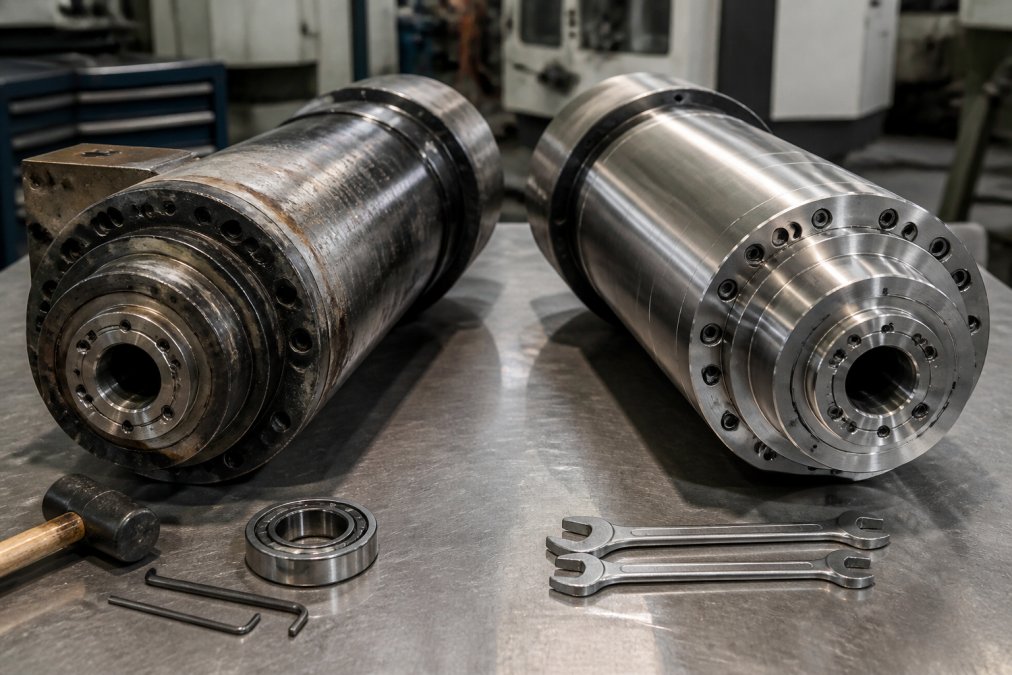
When the spindle fails, production stops. Deciding whether to repair, replace, or upgrade requires a systematic total cost of ownership (TCO) analysis that most manufacturers skip.
Understanding TCO Beyond the Repair Quote
A spindle rebuild takes two to four weeks and costs downtime or backup equipment rental.
TCO Framework: Five Cost Categories
1. Direct Repair or Replacement Cost
- Spindle rebuild: Pricing depends on the specific spindle, damage, and labor required.
- New spindle: Pricing depends on the OEM or aftermarket part, and specific model.
- Installation labor: Pricing depends on the complexity of the installation.
2. Downtime and Lost Production
- Calculate hourly machine contribution margin (revenue minus direct material and labor)
- A two-week rebuild on a machine can result in significant lost production.
- Backup equipment rental or outsourcing rarely eliminates loss entirely
3. Tooling and Setup Costs
- Repairing an old spindle may require re-qualification of tool offsets
- New spindles often have tighter runout specs, improving surface finish
- Budget for test cuts and verification. Accounting for these initial setup variables remains essential when projecting the broader CNC machining costs associated with long-term production cycles.
4. Remaining Useful Life (RUL) and Future Failures
- A rebuilt spindle carries a warranty; failure risk rises after.
- On a ten-year-old machine, other components (ways, ballscrews, controls) may fail first
- If you plan to keep the machine fewer than three years, repair is often better
5. Opportunity Cost of Capital
- A spindle replacement ties up cash that could fund a newer machine or tooling.
- If cash-constrained, repair buys time; if you have capital, replacement may accelerate ROI
The Repair vs. Replace Decision Matrix
Repair makes sense if:
- Machine is fewer than seven years old
- Spindle failure is the only major issue
- Downtime can be absorbed or mitigated
- You plan to keep the machine three+ more years
Replacement makes sense if:
- Machine is older than ten years with a history of failures
- Spindle failure coincides with thermal instability or accuracy drift
- You can justify capital investment through cycle time savings
- You plan to keep the machine five+ more years
Upgrade makes sense if:
- Current machine cannot handle your workload
- Repair costs exceed a significant portion of a new machine's price
- You need Industry 4.0 connectivity or advanced features
- Growth demands higher throughput or capability
Machine Tool Science Approach to TCO Diagnostics
We diagnose spindle problems systematically before quoting repair or replacement. Our technicians isolate the root cause and assess broader machine condition: way wear, thermal stability, and control system health.
CNC Machine Turnkey Installation and Industry 4.0 Integration
Turnkey installation includes delivery, foundation prep, electrical and coolant hookup, machine leveling, and software configuration, everything needed to run production on day one.
Vertical Machining Center Comparison: Top Models and Selection Criteria
Selecting the right vertical machining center depends on your workload, budget, and long-term strategy. Here's how leading models stack up:
| Model | Best For | Key Strength | Key Limitation |
|---|---|---|---|
| Haas VF-2SS | Job shops, rapid production | High-speed spindle, proven reliability | Lead times can extend during peak demand |
| Mazak Variaxis i-500 | Complex aerospace, medical parts | 5-axis simultaneous capability, thermal stability | Significant capital investment, steep learning curve |
| Doosan DNM Series | Heavy-duty production, cost-conscious shops | Rigid construction, low maintenance overhead | Limited high-speed features for light finishing |
| Machine Tool Science (Priminer dealer) | Manufacturers seeking expert support | Factory-trained service, transparent pricing, root cause diagnostics | Contact for current availability and lead times |
Selection criteria:
Frequently Asked Questions
What is the difference between a vertical machining center and a standard CNC milling machine?
A vertical machining center (VMC) is a type of CNC milling machine with the spindle oriented vertically. The key difference is that VMCs are designed for higher automation, featuring integrated tool changers, programmable logic control systems, and optimized work envelopes for rapid production. Standard CNC mills may have manual tool changes and less integrated automation. VMCs excel at drilling, tapping, boring, and milling plate-like components with precision and repeatability.
How often should you perform CNC machine maintenance on a vertical machining center?
Maintenance schedules depend on usage intensity and production volume. Daily checks include coolant levels, chip evacuation, and visual spindle inspection. Weekly maintenance covers tool changer function and axis travel verification. Monthly tasks include lubrication of ways and spindles, feed rate calibration checks, and tolerance verification. Quarterly inspections should include rigidity testing and surface finish assessment. Proactive maintenance prevents unplanned downtime and extends machine life significantly.
What is included in VMC spindle repair services?
Professional spindle repair services typically include diagnostic fault isolation to identify root causes, bearing replacement, spindle speed testing, thermal compensation verification, and reassembly with precision balancing. Factory-trained technicians assess metal removal rate performance and surface finish quality post-repair. Services may also cover spindle orientation correction and coolant system evaluation. Transparent diagnostic processes ensure you understand repair scope before costs are quoted, avoiding surprise billing.
What are the main advantages of 5-axis vertical machining centers over 3-axis models?
5-axis VMCs add two rotational axes (A and B) to the standard three linear axes (X, Y, Z), enabling simultaneous multi-angle machining. This reduces setup time for complex geometry, improves surface finish on contoured parts, and minimizes chip evacuation issues. 5-axis capability is essential for aerospace and defense work requiring high precision. However, 5-axis machines have higher capital investment and require more operator expertise. Most job shops and small-to-medium manufacturers succeed with 3-axis models for standard cavity and drilling work.
How does CNC machine turnkey installation work, and what should you expect?
Turnkey installation includes machine delivery, foundation preparation, electrical and coolant system hookup, control system programming, and operator training. Factory-trained technicians handle machinery moves, alignment, and commissioning to ensure the machine operates at specification. The process typically covers rigidity testing, spindle speed verification, and tolerance validation before handoff. Turnkey service minimizes your setup burden and reduces time-to-production, allowing your team to focus on manufacturing rather than installation logistics.